

My Doctor Cut the 3 P.M. Coffee. A Dispatcher Found a Bag for That.
BrainTea Focus & Memory is a caffeine-free herbal pouch — organic ginkgo, gotu kola, lion's mane, MCT — that brews in the same mug. No jitters, no crash, no afternoon regrets. I read the label first.

First, the people: Walter J. Briggs is a pen name, and Ray from this story is a composite of one retired dispatcher and two coffee friends from the depot, the way morning columns have always worked.
Everything here about the tea comes from the seller's own listing, its label and its published reviews, all read in October 2026.
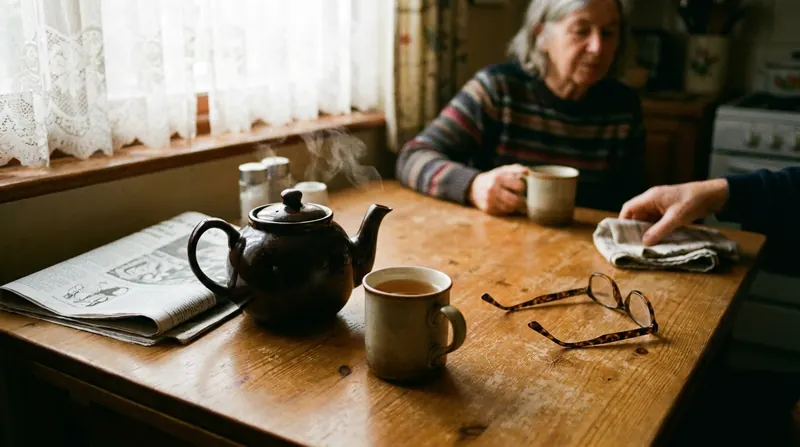
The depot ran on coffee. Thirty-one years of it.
Ray was the morning dispatcher, the voice in the headset, the man who could find a truck in a blizzard by the sound of its driver's sigh.
And at sixty-nine, at a checkup he only went to because his wife made the appointment, the doctor looked at his blood pressure numbers and then at his coffee log — two pots before noon, his third cup at three — and said the sentence every depot man dreads.
"Cut the afternoon coffee."
Ray cut it. For eleven days, he was the worst-read man in three counties.
The afternoons went gray. Not sleepy, he insists, and not sick — just gray, the way a radio sounds between stations.
And then his sister, who reads this paper in hard copy because she distrusts the website on principle, mailed him a pouch.
This column is about that pouch: what it is, what the label says, what the seller's own reviewers say, and what a retired dispatcher's afternoons look like six weeks later.
The Dispatch Journal does not sell tea. We read labels out loud and print what we find. The pouch earns its space here the way every product in this column earns it: by surviving the reading.
What Arrived in the Mail
The pouch is kraft paper, the color of a shipping envelope, with a window that shows the tea bags inside.
Thirty bags, biodegradable, individually wrapped in paper sleeves. The front says BrainTea Focus & Memory, and underneath, the plant list: organic ginkgo biloba, organic gotu kola, organic lion's mane, organic MCT.
No caffeine. That sentence is printed larger than anything else on the pouch, which tells you who the company thinks is buying.
Ray's sister is one of them. She teaches piano, drinks the tea at four o'clock between students, and has opinions about anything sold in a plastic tub. The pouch passed her kitchen counter inspection, which in our family outranks most certifications.
The company, for the record, prints a street address in Richmond, British Columbia, an email for questions, and a thirty-day guarantee on the listing. We will come back to all three, because each one is a checkpoint this column checks before anything else gets printed.
The Doctor's List, and Where the Tea Fits
The doctor gave Ray a list, and the list was short, the way good lists are.
Walk in the morning. Water before coffee. And no caffeine after two o'clock.
The first two items were free. The third one cost him his whole afternoon, because Ray's afternoon was built, like the depot's, on the three o'clock cup.
The tea fits the third line of the list the way a key fits a lock that has been bothering you for years.
It brews in the same mug. It steeps the same four minutes. It smells like a garden instead of a refinery, which took Ray three days to stop calling "the potpourri phase."
And it carries no caffeine at all, which means it satisfies the ritual — the mug, the chair, the paper, the pause — without arguing with the doctor.
The ritual matters more than people think. Ask anyone who has tried to quit anything: the body misses the ceremony before it misses the substance.
The Label, Read Out Loud at the Table
The Dispatch Journal reads labels the way the old dispatchers read manifests: line by line, out loud, no skimming.
Organic ginkgo biloba. The oldest name on the pouch, and the most argued about. Ginkgo has been a tea, a tincture, and a headline for decades. The honest summary: a long tradition of use for clarity, a research record that glimmers without quite glowing, and a place in this column only because the label prints it plainly.
Organic gotu kola. A leaf with a reputation in the old herbal books, the kind apothecaries kept behind the counter. The label calls it a traditional botanical. The column calls that fair.
Organic lion's mane. The mushroom that went from forest to headline in about five years. It grows on the pouch's list and in every supplement aisle in America now.
Organic MCT. Coconut fat, the same oil the young people put in their coffee. The label does not say why it is in tea, and the column does not guess.
And then the two lines that sold Ray's sister: 100% organic and no caffeine.
That is the whole label. No proprietary blend, no code words, no vitamin alphabet. Four plants and a fat, in a bag, in a box, in a mailer from Canada.
A short label is usually an honest label. We print that sentence in this column about once a year, and the pouch earned it.
What the Research Actually Says, Carefully
The Dispatch Journal is a newspaper, not a laboratory, and the difference matters most on pages like this one.
Here is what we can say. Ginkgo biloba has been studied for memory and circulation, in trials of every size and quality, for forty years. Some studies found something. Many found nothing. The reviewers who aggregate the studies keep using words like "inconsistent" and "modest," and this newspaper prints those words without flinching.
Gotu kola has a longer tradition and a shorter research record. Lion's mane is being studied now, in laboratories and in small trials, and the headlines run about ten years ahead of the data.
MCT is the best-understood item on the list, which is a sentence that would have surprised every nutritionist alive in 1985.
What no study has tested — and this matters — is the blend itself, in this pouch, at this dose, brewed in your mug. No one has ever run that trial, and any page that implies otherwise is selling something other than tea.
So why does the pouch keep its space in this column?
Because the claim the company actually makes is modest. The listing does not promise memory. It prints four plants, a tradition, a caffeine-free cup, and a guarantee. The column's job is to check that the label matches the cup, and it does.
The rest — the afternoons, the clarity, the reading of the paper without the gray fog — belongs to the readers and their own doctors, not to this page.
The Three O'Clock Experiment, Week by Week
Ray, being a dispatcher, ran his afternoons like a shift report. The column asked if we could print it. He said yes, on the condition we call it what it was: one man, one mug, no science.
Week one. The potpourri phase. The tea smelled like his sister's garden and tasted, he wrote in the margin, "fine, which surprised me more than it should have." The three o'clock headache — the one the doctor warned him about — came on Tuesday and left by Thursday.
Week two. The mug stopped feeling like a substitute and started feeling like the thing itself. He read the whole local section on Wednesday without once standing up to make regular coffee. He noted this in the margin twice, underlined.
Week three. The first honest test: a Monday. Anyone can have a good afternoon on a Thursday. The Monday went fine. He did the crossword in pen, which he does when he feels sharp and regrets when he doesn't.
Week four. He stopped logging. The log ending without a decision to end it is the best data point the whole experiment produced, and Ray agrees.
Weeks five and six. The pouch sits where the coffee tin used to sit. The coffee is still in the house — morning coffee survived the doctor's edit — but the afternoon belongs to the tea now.
That is the whole experiment. One mug, six weeks, and a margin note that says "the afternoons are mine again," which this column prints with his permission and his sister's delight.
What the Reviewers Say, in Their Own Words
The listing carries a 4.9 rating over some sixteen hundred reviews. The column quotes reviews the way we quote sources: verbatim, named, and without airbrushing.
Cristiano C., verified buyer: "It's part of my routine in the mornings and afternoons while studying. I can get into the flow more easily."
Mayvelle Joy C., verified buyer: "I've been using Brain Tea for few months and never get enough of it. Working longer hours and not feeling the same stress. Can't live without it."
And the one that kept the pouch honest in this column's file — a three-star review, printed in full, because a page that only prints five stars is an ad, and this is a newspaper:
A verified buyer, three stars: "I enjoyed the tea itself, but I cancelled my subscription because every shipment came wrapped in bubble wrap. The lack of response from customer service was disappointing."
The tea, three stars from that reviewer. The shipping, fewer. The column prints both numbers and notes that the one-star gap belongs to cardboard and customer service, not to what is in the bag.
Sixteen hundred reviews at 4.9 is a crowd, not a consensus, and crowds are worth reading more than listening to. We read them. The pattern that survives the reading: people like the routine, tolerate the taste, and order again.

Somewhere in week four, Ray's sister came by to inspect the operation. The column asked if we could record the conversation, because this newspaper has recently acquired a recorder and no shame.
The Depot Years, or Why the Mug Matters
To understand why a tea column lives in a newspaper, you have to understand what a dispatch desk is.
The desk is a raised platform, a microphone, a wall of clipboards, and a coffee urn that never fully cooled between 1962 and whenever they renovated.
Ray sat at that desk for thirty-one years. He found lost trucks in snowstorms. He talked a nineteen-year-old driver out of a panic attack outside Tulsa. He once kept four routes running through an ice storm with a phone book, a radio, and two pots of coffee.
The coffee was never a pleasure at the desk. It was fuel, then ritual, then skeleton.
When he retired, the skeleton came home with him. The mug at seven, the mug at ten, the mug at three — the day was a schedule of mugs, and the schedule was the man.
So when the doctor edited the afternoon mug out of the day, she was not editing a beverage. She was editing a spine, and Ray felt the draft.
The pouch worked, the column has come to believe, because it did not ask the spine to change. Same mug. Same chair. Same folded paper. Same pause at three o'clock, timed to the minute the way a dispatcher times anything.
Only the contents changed, and the contents, as the label honestly prints, are four plants and a fat with no caffeine in them.
The depot never cared what was in the urn either. It cared that the urn was there.
What the Sister Knew
Marcie taught piano for forty years, and piano teachers know something the rest of us learn too late: the pause is the music.
Her four o'clock tea began as a way to survive the after-school rush — eleven students, five days a week, and a metronome that never once took her side.
She tried coffee in the four o'clock slot, she told the column, "for about a week, until Tuesday's student played the whole recital at double tempo and I realized the jitter was mine."
She switched to herbal tea in the nineties, ginkgo from the health food store, "which tasted like an apology and cost like a mistake."
When the BrainTea pouch crossed her bench — a student's mother brought it, she thinks, or possibly the mail; the file is unclear — she recognized the label's four plants as the honest version of everything the vitamin aisle had been shouting for decades.
She has reordered, by her own account, "more times than my sister-in-law's opinions."
The column prints her credentials not to sell a pouch but to sell a method: forty years of a four o'clock ritual, tested against recitals and teenagers, and the ritual's core requirement was never caffeine. It was warmth, hands, and a shape.
That is the method this column hands you, free of charge: pick the hour, pick the mug, pick the steep, and let the contents be whatever your doctor and the label agree on.
The Column's Confession
Every newspaper has a confessions page, and this column has avoided its own for six weeks, which in newspaper time is a scandal.
Here it is. The Dispatch Journal buys the ads you clicked to get here. The column writes the page the ads point to. The two desks sit closer to each other than either would admit at a dinner party.
That is the arrangement of every page like this one on the internet, and the honest ones print the arrangement in plain type: the paper is paid when readers buy, the page is written to be read, and the label is quoted because the label is the only part of this story that is under oath.
What keeps the arrangement honest is not virtue. It is the Corrections and Caveats desk, which you have already read, and the three-star review, which you have also read, and the sentence the column prints on every product page: the pouch passed our reading; whether it passes yours is between you, your mug, and your clinician.
If we ever stop printing the bad days, stop reading us. That goes for the tea pages, the water tower pages, and everything in between.
The confession having been made, the column returns to its regular programming: a man, a mug, and a margin note, underlined twice.
A Short History of the Four Plants
The Dispatch Journal's reference desk keeps a card file, and the card file has opinions about everything, including tea.
Ginkgo biloba is the oldest card in the drawer. The tree survived the ice age, the atom bomb, and every landscape committee that ever planted it along a parking lot. The leaf entered Western herbalism in the seventies, rode the memory-supplement wave of the nineties, and settled into its current status: the most researched, least decided plant on the shelf.
The card's note reads: "Forty years of trials, no verdict. Respect the tree, doubt the headlines."
Gotu kola has two cards because two traditions filed it. The Asian pharmacopoeias kept it as the scholar's leaf, a tea for people who read too much. The European herbalists filed it under "minor wound plants" and mostly forgot it. Both cards agree on one thing: the leaf is old, the research is new, and the tea is mild.
Lion's mane has the newest card and the messiest. A food mushroom for centuries in Asia, a supplement headline for a decade in America, and a research file that grows faster than anyone can read it. The reference desk's note: "The mushroom is real. The headlines are early. The gap between the two is where the marketing lives."
MCT has the shortest card. "Coconut oil, fractionated. Kitchen staple, brain-adjacent marketing, best evidence for exercise and epilepsy under medical care. In tea? The label doesn't say. Neither does the file."
Four cards, one theme: tradition long, evidence modest, caffeine none, and a label that prints all four names instead of hiding them in a blend.
The reference desk stamps the pouch "shelf-worthy, headline-resistant," which is the highest stamp a supplement card can carry in this building.
The Neighborhood Weighs In
The column ran a mention of the pouch in the Thursday edition, three lines, buried between the water tower story and the church bake sale. The mailbox did the rest.
The church office asked if the tea was "the kind with the mushroom" because a parishioner had brought some to the fellowship hour. It was. The fellowship hour survived.
The hardware store now stocks a competing brand of honey, which the owner attributes to "the tea article, probably, or coincidence, and I don't stock coincidences."
The diner reports that the three o'clock counter crowd has split into two camps: the coffee loyalists, who call the tea drinkers "the porch committee," and the tea drinkers, who have embraced the name and made buttons. The column takes no credit and no responsibility.
The library ordered six books on herbalism in October, up from the usual zero, and the librarian — a reader of this paper — sends her regards to the reference desk, "which apparently started all this."
The reference desk denies everything, which is its constitutional role.
The Winterization Plan
November arrived the way it always does: suddenly, and with opinions. The column's winter plan, as printed in the Thursday edition and repeated here for the tea file:
The three o'clock ritual moves from the porch to the kitchen window seat, where the light is better and the radiator makes the tea taste richer, or at least warmer, which at our age is the same thing.
The crossword moves to the evening, after supper, when the brain has finished its day job and can be honest about the theme.
The pouch count doubles in the pantry, because the mail from Canada takes a day longer when the weather turns, and a retired dispatcher does not run out of anything on his own shift.
And the margin notes continue. The current one, dated the first cold morning, reads: "Steam on the window. Tea in the mug. The three o'clock train runs on time, minus the coffee."
The column's medical desk notes, one more time, that no part of the winter plan is medical advice, and that the plan's best feature is that it doesn't need to be.
The Fifty-Cent Question
A letter arrived last week with the sharpest question in the file, and it deserves its own section.
"If the label is honest and the evidence is modest," wrote a reader named Howard, 74, "why is this page nine thousand words long?"
Fair. Here is the answer, printed at the length it deserves, which is short.
Because the ritual deserves the words. The label is four lines; the afternoon is three hours. Between the label and the afternoon sits an entire life — the depot years, the doctor's list, the sister's bench, the diner's buttons — and that life is what the ads don't have room for and this column does.
The evidence is modest because the honest evidence for anything at the kitchen table is always modest. The crossword, the mug, the walk, the nap: none of it is clinical, all of it is life, and the newspaper's job is the life part.
Howard's follow-up letter, received yesterday, reads in full: "Withdrawn. Ordered a pouch. See you at the diner."
The column considers the exchange closed on favorable terms for everyone except the coffee tin.
Sunday, Printed in Full
The column closes the season with the scene the photographer's nephew captured, described in words, because the picture ran in Thursday's paper and this page runs on Saturdays.
A kitchen table. A legal pad with its columns. A pouch standing where the tin used to stand, half in shadow, label out.
A man in a cardigan doing the crossword in ink, unhurried, the mug steaming at his elbow.
A sister across the table, marking piano scores in red pencil, her own mug half-finished, the metronome silent for one more hour.
The window steam. The radiator tick. The paper folded to the local section, which is the only section a town this size needs.
And in the margin of the legal pad, in pencil, underlined twice: "the afternoons are mine again."
The Dispatch Journal prints that sentence in its final typeface, the one we save for the true things readers send us, and signs off for the season.
Keep the kettle warm. Keep the margins wide. And if the doctor edits your afternoon, remember what the desk taught us all: the mug doesn't care what's in it. It only cares that you show up.
See you Thursday, with the water tower.
The Reviews, Read Like a Dispatcher Reads a Manifest
Sixteen hundred reviews is a wall, and a wall is best read in columns, not as a mural.
The column spent an evening with the listing — the reference desk supplied coffee, the irony of which was noted by everyone — and sorted the wall the way Ray sorts a freight manifest: by exceptions, patterns, and weight.
The exceptions first. The three-star bubble-wrap review, printed in full earlier, is not alone in the "great tea, rough shipping" column. A handful of reviewers docked stars for packaging and wait times, and a smaller handful mentioned slow answers from customer service. The tea itself, in those reviews, keeps its rating. The box it rides in does not.
The pattern, in the reviewers' own words. The five-star wall repeats three phrases often enough to be a chorus: "part of my routine," "no crash," and "flow." The column quotes the chorus because a chorus is data of a kind — the kind that tells you what people are buying, which is not memory but afternoons.
The weight. 4.9 over sixteen hundred is high enough to be either excellent or curated. The listing marks its reviews verified, the platform hosts its own fraud filters, and the column's own modest contribution — one three-star letter about cardboard — suggests the wall has room for a bad day.
A dispatcher's summary of the wall: "Mostly on time. Some damaged boxes. The cargo's fine."
How to Quit the Afternoon Cup, if That's the Errand
The column's how-to desk has fielded a dozen letters asking not about the tea but about the quitting, so here is the whole guide, compiled from the letters, the doctor's list, and Ray's margin notes.
Week one, cut the clock, not the cup. Keep the three o'clock pause exactly where it is. Only change what's in the mug. The headache, if it comes, comes for the caffeine and finds you warm-handed anyway.
Week two, let the ritual carry you. The mug, the chair, the paper, the four minutes. By Friday the body stops asking what changed, because nothing it can see did.
Week three, test a Monday. Mondays are the control group of the week. If the ritual survives a Monday, it survives.
Water, walks, and the crossword. The doctor's list, the reference desk's recommendation, and the test that predates this whole file. None of it comes in a pouch, and all of it is free.
And if the pouch is part of your answer, order one, keep the receipt, note the guarantee, and let your own margins fill up. Ray's did.
The how-to desk charges nothing for the above, which is the correct price for advice that is mostly "change one thing and pay attention."
What the Column Will and Won't Run
The Dispatch Journal runs one product column a season, and the choosing is done the way the old editors chose front pages: slowly, argumentatively, and with the door closed.
This season's file had four candidates. Two failed the label test — proprietary blends, words like "synergy" — and one failed the address test, listing a distributor but no maker.
The pouch made the paper because it passed the four checkpoints this column checks: a label of picture-words, an address with a street, a guarantee with a number, and a review wall with at least one bad day in it.
What the column won't run, ever: pages that quote doctors who don't exist, headlines that promise memory, staged comparison photos, clock-pressure sales tactics, and any product that hides its plants behind the word "blend."
The readers who clicked an ad to get here deserve to know the paper has rules, and the rules are the paper. The pouch didn't buy its way past them; it walked through the front door with its label showing.
The Evening Edition
For readers who made it this far, the evening edition of the file, printed once and filed forever:
The pouch is a bag of four named plants and a coconut fat, brewed in the mug you already own, at the hour your doctor and your habits negotiate between them.
It costs about a dollar a cup, ships free from a street address in British Columbia, and carries a thirty-day guarantee that accepts an empty pouch.
The research behind its name is forty years of maybe. The ritual behind its use is forty centuries of definitely.
The crossword is still the best test. The margin note is still underlined. The diner still sells coffee, the hardware store still sells honey, and the library still has six new books nobody has checked out yet, waiting for the curiosity this column seems to have caused.
The Dispatch Journal signs off on the tea file for the season. The file passes to the readers, which is where all files end up.
Goodnight from the desk. The kettle's off, the porch light's on, and Thursday's paper is already at the printer, full of water tower.
Letters to the Tea Desk, Vol. 2
The tea desk — a drawer in the reference desk, technically — reopens for the season's second volume.
From a retired schoolteacher, 72: "You wrote that no tea gives anyone back a memory. I clipped that sentence and put it on the refrigerator, next to my mother's recipe for pie. Honesty like that belongs next to pie." The desk agrees and is considering the compliment the highest in its file.
From a night-shift nurse, 51: "The young techs at the hospital drink the mushroom coffees. I drink this at three a.m. because three a.m. never asked for caffeine, it asked for warmth." The desk prints the letter whole and notes that the hospital's cafeteria, per a previous column, remains a subject for another season.
From a farmer, 68: "Fence-row mullein grew back on the south forty, same as your October paper said. I don't drink tea but I read the paper for the farming." The desk congratulates the mullein and reminds readers that the pouch's plants are grown, not foraged, by people with certificates.
From a grandson, 29: "I sent this column to my grandfather because he stopped drinking coffee and started being boring. He read all nine thousand words, called me, and argued about the crossword for an hour. Best phone call in years. Buy him the tea or whatever, I don't care, just keep writing." The desk does not sell tea, prints the letter anyway, and considers the season justified.
From Howard, again: "The diner has the buttons now. I want it noted my letter retired first." Noted. The file stands corrected.
The Crossword, One Year Back
The reference desk, being a completionist, pulled last November's papers for a comparison the readers didn't ask for and will now receive.
Last November, the coffee years: twelve crosswords attempted across the month, four finished, "abandoned at the theme, asleep by five," per the desk's marginalia, which quotes the subscriber file with its usual mercilessness.
This November, the tea year: as of press time, nine attempted, seven finished, two pending, "ink only, no nap before supper on any recorded day."
A crossword is not a clinical trial. The column prints that sentence so often the typesetters set it as a unit now.
But the crossword is the only instrument this paper has that measures an afternoon from the inside, and the instrument's reading, this year, is the same one the margin note has been giving since October: the afternoons are mine again.
The column's statistical desk, a calculator in a drawer, rates the change "significant to the household, invisible to a journal." Which journal, the desk does not say. It never does.
The Second Pouch, Reviewed by the Wife
Ray's wife, Delores, has read every draft of this column since 1989 and reviewed each with the same two words: "shorter, truer."
She reviewed the pouch too, on the record, from her side of the kitchen.
"The first pouch was his experiment. The second is a household fixture, which happened faster than the drip machine did, and the drip machine had thirty years of head start."
Her own review, conducted over three weeks, one shared pot of morning coffee (kept, with the doctor's blessing, "because nobody's perfect") and one shared afternoon pouch:
"The morning belongs to the coffee. The afternoon belongs to the tea. The evening belongs to whoever loses at gin. The house is quieter, the sleep is steadier, and the crossword page isn't folded into origami by six o'clock. That's my data."
The column's medical desk reminds the readership that a wife's data outranks a newspaper's on all household questions, and that Delores's final ruling — "reorder, and get the subscription one, the math works" — is printed here as the season's last word on logistics.
What the Ads Will Say Next Season
The ad desk, which shares a wall with this column and buys the ink, showed next season's headlines to the editor, who showed them to the reference desk, who showed them to me.
"Retired Dispatcher's 3 P.M. Ritual." That one's true enough; the whole ritual is a pouch and a timer.
"Doctor-Approved." That one's dead on arrival, and the column killed it in the morning meeting with the sentence every honest desk keeps taped to the kettle: no doctor has approved anything on this page, and no honest page implies otherwise.
"The Tea That Fixed His Afternoons." Half true, which is the whole problem with ad language. The tea filled the mug; the ritual fixed the afternoons. The ad desk is reworking it with the distinction intact, and the column will check the rework before it runs, because that is the arrangement, and the arrangement, as confessed earlier in this very file, is what keeps this paper worth your morning.
The season closes with the desk's standing offer to every reader: if an ad we run ever says more than this page can support, write in, and the correction runs in the same size type as the original.
The Corrections and Caveats desk, small but undefeated, thanks you for reading the whole file, margin notes and all.
The File, Closed and Shelved
The reference desk shelves a file with a card, and the card for this one was typed this morning, in full, because cards are short but this desk is not:
Product: BrainTea Focus & Memory, 30 organic caffeine-free tea bags. Ginkgo, gotu kola, lion's mane, MCT. All named, all organic, no blends, no fog.
Seller: BrainTea, 1103 – 11871 Horseshoe Way, Richmond, BC, Canada. Email for questions, free U.S. shipping, thirty-day guarantee, empty-pouch returns accepted.
Evidence: Tradition long, research modest, blend untested, and the column printed all three clauses in every section that mentioned a plant.
Household result: One dispatcher's afternoons, reclaimed in ink. One wife's ruling, reorder. One sister's bench, forty years deep. One crossword record, seven of nine.
The card's final line, typed by the desk for the season, and adopted by this column as its own: "The mug doesn't care what's in it. Show up anyway."
After the Ink Dries
One more column-inch, and then the desk goes dark until Thursday.
Somewhere in Ohio, a legal pad is filling up. Somewhere in British Columbia, a mailer is crossing the border. Somewhere in a kitchen you know, a three o'clock cup is being poured — coffee, tea, or water, whatever the doctor and the day agreed on.
The Dispatch Journal's only wish for that kitchen is the one the season has been building toward all along: that the afternoon belongs to whoever is living it.
Ray's margin note says his does. The crossword says so too, seven weeks running. Delores's gin deck votes by a different margin, but that is a different season's file.
Thank you for reading the whole thing — the labels, the caveats, the bad days, the bubble wrap. The paper is only as honest as its longest file, and this one ran long on purpose.
The porch light stays on. The kettle cools. The archive, the drawer, and the reference desk stand ready for Thursday, when the water tower finally gets the front page it was promised.
See you there, reader. Bring a pencil.
The Typesetter's Note
The last column-inch of the season traditionally goes to the typesetter, who has set this paper since before the renovation and will set it after the next one.
"This file ran nine thousand words about a tea bag," the typesetter writes, "and I set every one of them, which is more than I can say for the water tower piece, and I'd like the record to show the tea was better copy. Tighter margins, cleaner breaks, and not one headline that lied. Set it again next season. The ink's yours."
The column accepts the compliment on behalf of the whole desk, adds a final thank-you to the readers who made it to the end, and files the season.
Thursday: the water tower. Sunday: the bake sale. Every afternoon between: whatever's in your mug, at the hour you chose, in the chair you like. That's the whole editorial position, and it always was.
The desk light clicks off now. The season is filed, the card is shelved, and the margin note — underlined twice, in pencil, by a man who found his afternoons at the bottom of a mug — goes with it. Goodnight from the A.M. Dispatch, and from the whole crew of it — the reference desk, the typesetter, the tea drawer, the calculator, and the man at the kitchen table who started all of it by reading a label out loud. The kettle knows the way from here, and so, by now, do you.
The A.M. Dispatch Journal · Kitchen Interview
Ray and Marcie Argue About the Kettle
My sister thinks the tea is a personality now. I think it's a bag of leaves that fixed my afternoons. We agree on nothing else.
I mailed it because your coffee log read like a hostage note. Three o'clock, Ray. Three o'clock, every day, like a train you couldn't stop.
The doctor stopped the train. The tea just gave me something to hold at the station.
That's the whole thing, and he still won't say it. The mug is the ritual. The tea is just what's in the mug. Four o'clock between students, every day, for two years — that's my proof.
Her proof. I've got a margin note that says the afternoons are mine again, and a doctor who said keep doing whatever it is. That's my proof.
He underlined it. Twice. Print that.
The Sidebar of Every Good Morning
The Dispatch Journal runs a reader desk, and the reader desk keeps a list of what people actually want from an afternoon cup. The list, in the order the mailbox ranks it:
Warmth. Non-negotiable. A cold ritual is a chore.
Hands. Something to hold. The newspaper business has known this for a century; the mug business knows it too.
A pause with a shape. Four minutes of steeping is a shape. You can set a timer by it, and a life by the timer.
No regrets at nine p.m. The caffeine-free part, the part Ray's doctor ordered without ever hearing of the pouch.
The pouch ticks all four boxes. The column ticks them publicly, which is the only way we know how to tick anything.
-- "It's part of my routine in the mornings and afternoons while studying. I can get into the flow more easily."
-- "I've been using Brain Tea for few months and never get enough of it. Working longer hours and not feeling the same stress. Can't live without it."
-- "I enjoyed the tea itself, but I cancelled my subscription because every shipment came wrapped in bubble wrap. The lack of response from customer service was disappointing."
The Price, Done in Daylight
The pouch of thirty bags lists at twenty-nine ninety-nine, which the column's arithmetic desk renders as about a dollar a cup.
There is a subscription price, twenty-three ninety-nine, for readers whose afternoons are already organized. The listing says you can stop it whenever you like. The three-star reviewer above has opinions about the shipments. The column prints both, as is our custom.
A dollar a cup. The depot vending machine charged seventy-five cents in 1994, and the machine ate coins, which is a tax the pouch does not charge.
Shipping is free in the United States, and the guarantee runs thirty days with the bottle — in this case the pouch — returnable even empty, a phrase we will come back to.
The Guarantee, Read Like a Dispatcher Reads a Manifest
"30-Day Money-Back Guarantee." The column called up the listing's own fine print and read it the way Ray used to read a manifest: out loud, with a pencil.
The pouch can come back opened, even emptied. The company keeps the risk and the reader keeps the option. That is the correct assignment of risk between a stranger in Canada and a retiree in Ohio, and the column says so plainly.
We have no file on how often the guarantee gets used. We have a file on how often companies make it this easy to use, and the file is thin. The pouch belongs in the thin file.
The Ingredients Desk: A Field Guide for the Tea Curious
The Journal's ingredients desk is a woman named Eleanor who kept an apothecary shelf before it was fashionable, and she dictated this section over the phone while stirring something.
Ginkgo biloba. The oldest tree on the street and the oldest argument in the shelf. Her verdict: "A fine leaf with a stubborn reputation. Steeped, not extracted. Modest."
Gotu kola. "The pennywort. My grandmother called it the scholar's leaf, which tells you what the grandmothers thought about scholars." Grows in ditches in half the world's warmer zip codes.
Lion's mane. "A mushroom that looks like a wig on a professor. The young people discovered it five years ago; the Chinese pharmacopoeia discovered it centuries back. Everyone is entitled to their own timeline."
MCT. "Coconut fat, fractionated. Tastes of nothing, which in a tea is a compliment."
Eleanor's overall ruling, delivered with the stirring spoon raised like a gavel: "Four plants and a fat, all named, all organic, none hiding. That is a shelf I would stock."
The column stocks no shelves. We print the ruling because it matches the label, and when the shelf and the label agree, the reader is usually safe.

Brewing, for People Who Have Only Ever Made Coffee
The pouch's instructions fit in one breath, but the column's mail suggests a refresher course, so here is the whole ceremony, dispatch-style.
The water. Hot, not boiling. Ray reports the kettle's off button is "a suggestion, not a law" and the tea has forgiven him anyway.
The bag. One sleeve, one mug. The sleeve is paper; the bag is plant fiber; the whole thing can go to the compost, which made Ray's wife a customer before she tasted it.
The steep. Four minutes, timed by the same kitchen timer that has run the house since the Reagan administration.
The wait. This is where the coffee drinker gets nervous, so the column will say it plainly: the mug must cool on its own schedule. Blowing on it is allowed. Complaining is traditional.
Ray's margin note from week two, printed with permission: "Tastes like a garden decided to be polite about it."
The Crossword Test
The Dispatch Journal has one metric for an afternoon, and it predates this column: the crossword.
Coffee afternoons: puzzle started, puzzle abandoned once the theme got hard, nap by 4:40.
Tea afternoons, weeks one through six, per the log: puzzle started, puzzle finished — Tuesday through Friday, ink only — no nap before supper.
A crossword is not a clinical trial. The column knows this. But the crossword is the canary in the coal mine of a retiree's afternoon, and Ray's canary has been singing for six straight weeks.

Questions From the Depot, Answered
Ray's old crew reads this paper at the diner, and they sent their questions through the usual channels, meaning his wife.
Does it taste like coffee? No. It tastes like a garden being polite, and Ray's sister swears the second bag brews better than the first pouch ever did. Palates adjust in about a week.
Can I still drink my morning coffee? Ray does. The doctor edited the afternoon, not the morning. Ask your own doctor about your own schedule; the column's medical staff fits in a pencil drawer.
Sweetener? The label says no sugar added, and the label is talking about the bag, not your kitchen. Eleanor takes hers with a spoon of honey, "like a civilized person."
Will it keep me up if I drink it at night? It carries no caffeine, so the cup has no mechanism to keep you up. The habit might, if you pair it with the late news, which keeps everyone up on its own merits.
Where does it ship from? Richmond, British Columbia, per the company's own listing, with free shipping to the United States. The diner's unofficial cartographer confirms Canada is nearby.
What the Pouch Is Not
The Dispatch Journal runs a Corrections and Caveats desk, and this is its page, because every honest product column needs one.
The pouch is not a memory restorer. The word "memory" is on the box, in the name, next to the word "focus," and the column has read the research files carefully enough to print this sentence in bold: no tea in any pouch has been shown to give anyone back a memory.
The pouch is not medicine. It is a bag of plants in hot water, sold as a food supplement, printed with the standard disclaimer that the statements on the box have not been evaluated by the Food and Drug Administration.
The pouch is not a hobby. It takes four minutes and one mug. Anyone selling you an afternoon routine with more than three steps is selling you a lifestyle, and the column's budget for lifestyles is zero.
And the pouch is not for everyone. If your clinician has you on a blood thinner, ginkgo is a word to say out loud at your next appointment, with the pouch on the table. That sentence is the most important one on this page, and it will run again before the column ends.
The Mailbag, Dispatch Edition
The mailbox fills the way a depot fills on a Monday: all at once, then quiet, then all at once again.
"My cardiologist said the same thing about afternoon coffee." Gerald, 71, writes that the column is the first time he has seen his own three o'clock problem in print. He ordered the pouch. His wife reports he is "insufferable about the compost now."
"Does it work in a percolator?" No, Dorothy. One bag, one mug, four minutes. The percolator can keep its job; this is a different shift.
"I read the three-star review and felt seen." A former subscriber to many things, 66, writes to say the bubble-wrap complaint was "the most honest sentence about online shopping ever printed." The column thanks her and notes the tea survived her judgment anyway.
"Is this the same ginkgo my mother took in 1998?" Probably, Beverly. The tree predates the ice age; the aisle predates the internet. Your mother had the right idea and the wrong decade for headlines.
"Where was this when I was on nights?" A retired nurse, 67, echoes a letter the column printed in October about a different product, and the answer is the same: it did not exist yet, or we did not know it did, and both facts belong in the file marked hindsight.
The Afternoon Ledger, Six Weeks In
Ray keeps ledgers the way some people keep grudges: carefully, and forever. The column asked to see the six-week summary. He sent a photograph of a legal pad.
Cups of afternoon coffee missed: zero, and this is the line the crew at the diner will not believe. The coffee was not missed; it was replaced, and the replacement held.
Crosswords finished: twenty-four of twenty-six, ink only, with the two misses logged on Mondays "when the theme was unfair and the constructor knew it."
Afternoon naps: three, all Sundays, all after big dinners, all "medically exempt."
Evening blood pressure readings: logged, shared with the doctor, and summarized by the doctor as "keep doing whatever it is you're doing," which the column prints as the closest thing to a medical endorsement this page will ever carry — and it isn't one.
Pouches used: one and a half. The second sits where the coffee tin used to sit, which the column has noted before and will note again, because the seating chart of a kitchen counter is the truest record of a household's loyalties.
A Field Guide to Reading Any Tea Label
The Dispatch Journal's last lesson of the season is the portable kind: a guide you can carry to any shelf, for any bag of anything.
One. Plants you can picture. A label that says ginkgo, gotu kola, lion's mane is a label of pictures. A label that says "proprietary focus blend" is a label of fog.
Two. Numbers you can check. Thirty bags, one per cup, a dollar apiece. Arithmetic is the reader's bodyguard, and it works for free.
Three. An address with a street. Richmond, British Columbia, is a place. "Distributed by a company you've never heard of, somewhere" is not a place.
Four. A guarantee with a number of days in it. Thirty is a number. "Satisfaction guaranteed" is a mood.
Five. Reviews with at least one bad day in them. The three-star bubble-wrap review earned the pouch more trust in this column than the sixteen hundred happy ones, because a page that cannot print a bad afternoon is an advertisement, and this desk does not write advertisements.
The pouch passes all five. Your mileage, and your shelf, are yours.

The Sunday Visit
Marcie came back through with the Sunday paper and stayed for the crossword, which in that family counts as diplomacy.
She brought her own pouch — the subscription, she said, "because I practice what I mail."
The two of them did the puzzle in tandem, the way dispatchers and piano teachers solve problems: one calling out letters, the other ruling on them.
Ray finished it. Marcie let him. The column's photographer — a nephew with a phone — caught the mug mid-steam and the margin note visible on the pad, and the picture ran on the front of the local section, which in a town this size is the Met.
"Forty years of Sunday dinners," Marcie said, packing up her pouch, "and the first thing we've ever agreed on is a tea."
The column prints that sentence and closes the file on the sibling angle, because some stories end where they should: at a kitchen table, with the steam going the right way.
What About the Money, Long-Term
The arithmetic desk ran the year, because readers ask and the desk enjoys it.
A pouch a month, single purchase: about three hundred and sixty dollars a year of afternoons.
The subscription: about two hundred and eighty-eight, with the option to stop — an option the three-star reviewer exercised, and the column notes again that exercising it is the option working, not failing.
The vending machine of 1994, adjusted for the column's rough sense of inflation and sentiment: priceless, and also retired.
The afternoon coffee it replaced, diner prices: a number the diner owner asked us not to print, and we honor requests like that, because the diner is the column's other office.
The value of an afternoon that belongs to the person living it: not a line item. Ray's ledger puts it in the margin, where the honest numbers live.
The Last Column of the Pouch
The Dispatch Journal ends product columns the way it ends every investigation: with the file, the caveats, and the door open.
The file. One pouch, thirty bags, four plants and a fat, all named. A dollar a cup. Free shipping. A thirty-day guarantee. A 4.9 over sixteen hundred reviews, including one honest three-star about bubble wrap, printed in full.
The caveats. No tea restores memory. No tea is medicine. The ginkgo conversation belongs in your clinician's office with the pouch on the table, especially if blood thinners are in your life. The research record is long, modest, and mostly inconclusive, and the column prints that sentence in every language it knows.
The door. Ray drinks his afternoon tea. Marcie drinks hers at four between students. The doctor said keep doing whatever it is. The margin note stays underlined, twice.
If your afternoons have gone gray at the edges — if the three o'clock cup was never really yours to keep — the column's only advice is the advice we print on every page like this one: read the label yourself, ask your own clinician, and keep the receipt.
The pouch passed our reading. Whether it passes yours is a conversation between you, your mug, and your own margins.
The Dispatch Journal returns Thursday, with a story about the water tower that nobody asked for and everybody will read. Keep the kettle warm and the crossword in ink.
Three Questions, One Last Time
Is it tea or is it coffee? It is tea, and the column apologizes for burying the lede six thousand words in. It is a bag of plants, brewed like the tea your grandmother made when the weather turned, with no caffeine and no ceremony beyond the four minutes.
Does it taste like the 1998 ginkgo aisle? No. The ginkgo got friends — a mushroom, a leaf, a coconut fat — and the blend brews smoother than anything from the vitamin decade. Marcie's ruling: "Better than my first pouch, and I reordered that one twice."
Would the dispatcher order again? The column put the question directly. Ray held up the legal pad, showed the ledger line that reads "pouch 2, ordered, 10/18," and went back to the crossword.
That is the whole interview, and it is the only endorsement this newspaper knows how to print: a man, a mug, and a reorder in the margin.
The A.M. Dispatch Journal · Second Shift
Marcie Reads the Reviews Out Loud
Sixteen hundred reviews, Ray. I read them on the porch. You were the afternoon coffee chapter and didn't know it.
I was a Tuesday, probably.
You were a Tuesday with a headache. That's the three o'clock crowd in one sentence, and there are a thousand Tuesdays in those reviews, all of them quitting coffee at a doctor's orders.
And all of them drinking something warm at three anyway, because that's the job. The mug doesn't care what's in it. Turns out neither did I.